Your Canadian Pregnancy Timeline: What to Really Expect
I'm based in Ontario, so this reflects my experience here — some details may vary by province.
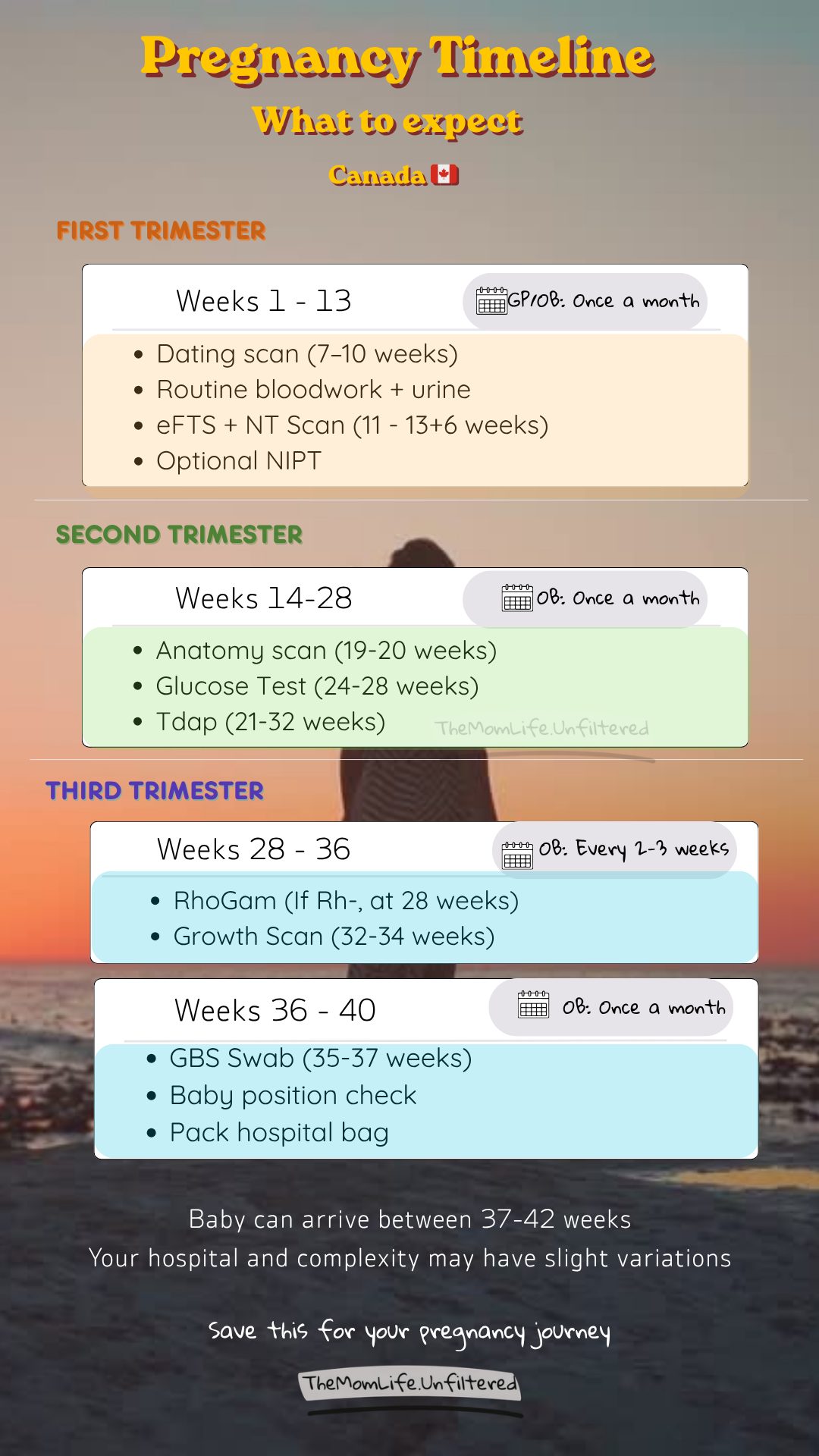
Save this infographic. Seriously, screenshot it now. But there's something the chart doesn't tell you that catches most first-time moms in Canada completely off guard.
Most OBs in Canada won't see you until after your 20th week. Yes, you read that right. Halfway through your pregnancy.
There's also the midwife route, which is a wonderful option many Canadian moms choose but here, I'm focusing specifically on the OB path.
There are exceptions, of course. But for the majority of first-time moms going the OB route, your family doctor or even a walk-in clinic doctor will be your main point of contact for the first half of your pregnancy, putting in requisitions for bloodwork, ordering your scans, managing your care until an OB takes over.
Knowing this ahead of time matters. It changes how you advocate for yourself. It changes who you call when something feels off. And it means building a relationship with your family doctor early is one of the most important things you can do in those first weeks.
My experience
My family doctor managed most of my prenatal care in the first half. That was completely normal, and honestly, he was incredible.
But then, during my NT scan — the nuchal translucency ultrasound done around 11–13 weeks — they discovered I had an internal bleeding episode, a subchorionic hemorrhage (SCH). I ended up in the ER, terrified.
On my family doctor's recommendation, I reached out and asked my OB to see me earlier than the typical schedule. She agreed, and I'm so grateful she did. The bleeding resolved on its own but having that OB visit, being seen and monitored, gave me a peace of mind I desperately needed.
The point isn't to scare you. SCH is more common than people talk about, and many resolve without intervention, like mine did. The point is: you are allowed to advocate for yourself. You are allowed to ask. An earlier OB visit isn't a demand, it's a request, and when there's a medical reason, most will accommodate.
What this means practically
Establish care with a family doctor early, they are your primary contact in trimester one.
No family doctor? Walk-in clinics can put in requisitions for bloodwork and early scans.
If something feels wrong, go to the ER. You don't need OB clearance to seek emergency care.
If you have a medical concern, it's okay to ask your OB for an earlier appointment.
The Canadian system works but it works best when you understand how it's structured and feel confident navigating it.
You're not being dramatic. You're not bothering anyone. You're being your own best advocate, and that's exactly the kind of mom you already are.
Save the timeline. Share it with a friend who just got a positive test. And if you're in the thick of a scary first trimester moment right now, you are not alone.
Coming up in Part 2: How to find an OB in Canada.
This post reflects my personal experience with prenatal care in Ontario, Canada. Every pregnancy, hospital, and referral process is different — always follow the guidance of your own healthcare provider.
I'm Rohini — first-time mum, figuring it out without a local village, and sharing the unfiltered reality of motherhood over at @themomlife.unfiltered.
If this resonated, I'd love to hear your story in the comments. Also, do check out my other blogs.